If you’re sourcing from China and selling on Amazon, Shopify, or any cross-border platform, you’ve seen these cryptic three-letter abbreviations on supplier quotes: EXW. FOB. CIF. DDP. But here’s what most suppliers won’t tell you — choosing the wrong Incoterm can quietly add 15-30% to your landed cost, expose you to CBP penalties, or get your FBA shipment rejected at the dock.
Incoterms 2020 — published by the International Chamber of Commerce (ICC) — defines 11 standardized rules that allocate cost, risk, and responsibility between buyer and seller. But they do not govern ownership transfer, payment terms, or applicable law. Understanding the difference between “where cost transfers” and “where risk transfers” is the single most important concept in international trade.
This guide walks you through all 11 terms, shows you exactly where the seller’s obligation ends and yours begins, and gives you a decision framework tailored to e-commerce sellers — especially those shipping to Amazon FBA.
What Incoterms 2020 Actually Does (and Doesn’t) Do
Before diving into the 11 rules, three things every seller must understand:
1. Incoterms split responsibility along TWO parallel lines:
- Cost line: Who pays for freight, insurance, clearance at each stage?
- Risk line: At what point does the risk of loss or damage transfer from seller to buyer?
These two lines don’t always align. Under C-group terms (CFR, CIF, CPT, CIP), the seller pays for main carriage, but risk transfers much earlier — at the origin port or first carrier. This is the #1 source of disputes in international trade.
2. Incoterms 2020 has 11 rules in two categories:
- 7 multimodal rules (any transport mode): EXW, FCA, CPT, CIP, DAP, DPU, DDP
- 4 sea-only rules (maritime transport): FAS, FOB, CFR, CIF
3. Two key changes from Incoterms 2010:
- DAT → DPU: “Delivered at Terminal” was renamed “Delivered at Place Unloaded” — the seller now unloads at any named destination, not just terminals
- CIP insurance upgraded: CIP now requires Institute Cargo Clauses (A) — all-risks cover. CIF stays at Clauses (C) minimum
💡 ICC’s explicit guidance: For containerized cargo, use FCA, CPT, or CIP — NOT FOB or CIF. FOB/CIF only apply when goods physically cross the ship’s rail, which doesn’t happen with containers handed to a terminal. Yet countless Chinese suppliers still quote FOB out of habit.
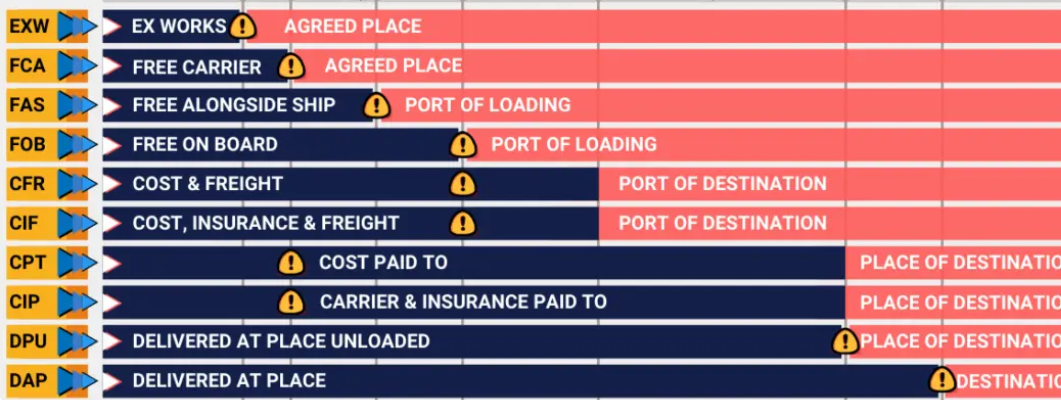
The Complete Incoterms 2020 Responsibility Matrix
Here’s the definitive reference table for all 11 rules:
| Term | Mode | Risk Transfers At | Export Clearance | Import Clearance | Insurance |
|---|---|---|---|---|---|
| EXW | Any | Seller’s premises (buyer collects) | Buyer | Buyer | Not required |
| FCA | Any | Handover to first carrier | Seller | Buyer | Not required |
| FAS | Sea | Goods alongside ship | Seller | Buyer | Not required |
| FOB | Sea | Goods on board vessel | Seller | Buyer | Not required |
| CFR | Sea | Goods on board vessel | Seller | Buyer | Not required |
| CIF | Sea | Goods on board vessel | Seller | Buyer | Seller (min. cover) |
| CPT | Any | Handover to first carrier | Seller | Buyer | Not required |
| CIP | Any | Handover to first carrier | Seller | Buyer | Seller (all-risks) |
| DAP | Any | Destination, ready for unloading | Seller | Buyer | Not required |
| DPU | Any | Destination, after unloading | Seller | Buyer | Not required |
| DDP | Any | Destination, duty paid | Seller | Seller | Not required |
*Source: Incoterms 2020, International Chamber of Commerce *
Read more amazon:Amazon AWD + LCL: Building a Hands-Free Replenishment Engine from China to FBA in 2026
The E-Group: EXW — Seller’s Minimum Obligation
EXW (Ex Works): The seller makes goods available at their premises. The buyer bears all costs and risks from that moment — including loading, export clearance, ocean freight, insurance, import duties, and final delivery.
For e-commerce sellers:
- ✅ Looks cheap on supplier quotes (excludes all logistics)
- ❌ You must arrange pickup from a factory in a foreign country, handle export clearance (which you may not be legally able to do), and manage every downstream step
- ❌ If your supplier is in China and you’re in the US, you need a China-based freight forwarder to execute export clearance on your behalf — which most small sellers don’t have
⚠️ Reality check: EXW only makes sense if you have a trusted freight forwarder with boots on the ground at origin. For most Amazon sellers, EXW is a trap — the quoted price looks attractive, but the operational burden and hidden costs far exceed the savings.
The F-Group: FCA — The Modern Replacement for FOB
FCA (Free Carrier): The seller clears goods for export and delivers them to a carrier nominated by the buyer at a named place. Risk transfers at handover.
Why FCA beats FOB for container cargo:
- FOB was designed for breakbulk cargo loaded directly onto ships. With containers, goods are handed to a terminal weeks before the ship arrives
- FCA reflects this reality: risk transfers when the container is handed to the carrier, not when it’s “on board”
- FCA applies to any transport mode — road, rail, air, sea, multimodal
- The ICC explicitly recommends FCA over FOB for containerized shipments
For e-commerce sellers:
- ✅ The cleanest split of responsibility for container shipping
- ✅ You control the main carrier selection and freight rate
- ✅ Your forwarder handles origin logistics where they have local expertise
- ⚠️ You need import infrastructure (customs bond, POA, IOR) at destination — which Amazon FBA sellers don’t have (see DDP below)
The Sea-Only Group: FOB, CFR, CIF — Traditional but Tricky
FOB (Free on Board): Seller delivers goods on board the vessel at the named port. Risk transfers at the ship’s rail.
CFR (Cost and Freight): Seller pays freight to destination port, but risk transfers at origin (on board).
CIF (Cost, Insurance, and Freight): Like CFR, but seller also procures minimum insurance (Institute Cargo Clauses C — essentially just “free of particular average” coverage).
The CIF trap every e-commerce seller must know:
💡 Critical misconception: Many new sellers think “CIF means the seller insures my goods for the whole journey.” False. Under CIF, the seller only procures minimum coverage (110% of invoice value, Clauses C). If cargo is damaged mid-ocean, the buyer bears the risk — the insurance policy pays the buyer, but the seller has no further liability. For high-value electronics, this minimum coverage is dangerously inadequate.
Modern guidance: For containerized cargo, replace FOB with FCA, CFR with CPT, and CIF with CIP. The C-group trap remains: seller pays freight, but buyer bears risk from origin. If the ship sinks, you’ve paid for freight you never used and bear the loss.
The C-Group (Multimodal): CPT, CIP — The Container-Era Equivalents
CPT (Carriage Paid To): Seller pays carriage to destination; risk transfers at first carrier handover.
CIP (Carriage and Insurance Paid To): Like CPT, but seller must procure all-risks insurance (Institute Cargo Clauses A). This is the most buyer-protective insured term in Incoterms 2020.
For e-commerce sellers:
- ✅ CIP is excellent for high-value goods — you get all-risks coverage paid by the seller
- ✅ Works for any transport mode
- ⚠️ Same C-group trap: risk transfers early, so if the seller’s chosen carrier is unreliable, you bear the consequences
The D-Group: DAP, DPU, DDP — Seller Carries Risk to Destination
DAP (Delivered at Place): Seller bears all costs and risks to bring goods to the named destination, ready for unloading. Buyer handles import clearance and duties.
DPU (Delivered at Place Unloaded): Like DAP, but the seller must unload at destination. The only Incoterm where the seller physically unloads.
DDP (Delivered Duty Paid): The seller’s maximum obligation — handles everything, including import duties, taxes, and customs clearance at destination.
The E-Commerce Seller’s Decision Framework
Now that you understand the 11 rules, here’s how to choose for common e-commerce scenarios:
🛒 Scenario 1: Shipping to Amazon FBA (US, EU, UK, AU, etc.)
Mandatory: DDP. No exceptions.
Amazon’s official seller guidelines are unambiguous:
“All shipments are required to use Delivered Duty Paid (DDP)… Any shipment arriving at an Amazon fulfilment centre with collect charges, including any duties, taxes, or shipping costs, will be refused without further concession.”
⚠️ “Amazon, including our fulfilment centres, will not act as an Importer of Record (IOR) for any shipment of FBA inventory.”
Why this forces DDP:
- Amazon won’t clear customs or pay duties on your behalf
- If duties are collect on arrival, the shipment is rejected and returned at your expense
- You (the foreign seller) typically can’t legally act as US IOR without a US entity
- Therefore, your freight forwarder must act as IOR under DDP terms, clearing and paying duties on your behalf, then charging you via the all-in quote
This is why the previous article in this series — DDP vs. DAP for Amazon FBA — concluded that DDP isn’t optional for FBA; it’s mandatory. (See that article for the full compliance deep-dive.)
🛒 Scenario 2: Shipping to Your Own US 3PL or Warehouse
Recommended: FOB or FCA
If you have US import infrastructure (customs bond, POA, EIN, a US entity), FOB or FCA gives you:
- Control over carrier selection and freight rates
- Ability to claim duty drawbacks
- Transparency into actual duty payments
- Flexibility to use your own customs broker
FOB is simpler if your supplier is traditional and insists on it. FCA is more modern and ICC-recommended for containers.
🛒 Scenario 3: Dropshipping or Direct-to-Customer (B2C)
Recommended: DDP or DAP
- DDP if you want a true “landed cost” price with zero hassle for your end customer (common for B2C cross-border)
- DAP if your customer is capable of handling import clearance (rare in B2C, but relevant for B2B dropshipping)
💡 For DTC brands selling to consumers, DDP is the gold standard — customers see one price, receive goods with no surprise duty bills, and you build trust.
🛒 Scenario 4: Shipping from China to Amazon EU/UK
Mandatory: DDP (same as US FBA)
But with an added twist: VAT. Under DDP, your forwarder pays VAT upfront. If you have an EU/UK VAT registration, you may prefer to act as your own IOR under DAP/FOB to recover VAT — but this requires local import infrastructure. For most sellers, DDP remains the pragmatic choice.
🛒 Scenario 5: First-Time Importer, No Import Infrastructure
Mandatory: DDP
If you’re new to importing, lack a US entity, customs bond, or POA, DDP is your only compliant option for any destination. The forwarder handles everything; you pay one all-in price.
(H2) The 5 Costliest Incoterm Mistakes E-commerce Sellers Make
❌ Mistake 1: Thinking CIF = full insurance coverage
✅ Fix: CIF only requires minimum Clauses C coverage. For high-value goods, insist on CIP or negotiate additional insurance separately.
❌ Mistake 2: Using FOB for container cargo
✅ Fix: Switch to FCA. Risk transfers when goods are handed to the carrier — which reflects the actual container journey. FOB’s “on board” moment is artificial for containers.
❌ Mistake 3: Booking DAP to Amazon FBA
✅ Fix: Amazon will reject the shipment. Only DDP is compliant. See our previous article DDP vs. DAP for Amazon FBA.
❌ Mistake 4: Treating EXW as “cheapest option”
✅ Fix: EXW shifts all operational burden to you. If you can’t execute export clearance in China, the “savings” evaporate. For most sellers, FOB or DDP is more cost-effective once hidden costs are counted.
❌ Mistake 5: Not specifying “Incoterms 2020” in your contract
✅ Fix: Always write the full term with version and named place: “FOB Shanghai Port, Incoterms 2020” or “DDP Amazon ONT8, Incoterms 2020”. Without the version year, disputes arise over which rule set applies.
Incoterms 2020 Quick-Select Reference
| If you are… | And you want to… | Use this term |
|---|---|---|
| Amazon FBA seller | Ship compliantly with zero hassle | DDP (mandatory) |
| Established importer | Control freight & carrier selection | FOB or FCA |
| Established importer + high-value goods | Add all-risks insurance | CIP |
| B2C brand, direct to customer | One-price landed cost | DDP |
| B2B dropshipping | Customer handles clearance | DAP |
| Shipping from China, no import infra | Outsource everything | DDP |
| Container cargo, traditional supplier | Pragmatic compromise | FOB (ideally FCA) |
| Air freight shipment | Seller pays air carriage | CPT or CIP |
The Amazon FBA Reality: DDP Is Not Optional
Let’s be crystal clear about what Amazon’s policy means for your Incoterm selection:
- Amazon will NOT act as IOR — for any FBA shipment, of any size, from any origin
- All shipments MUST be DDP — collect charges (duties, taxes, freight) result in automatic rejection
- Your forwarder becomes the de facto IOR — they clear customs, pay duties using their bond and POA, and charge you via the all-in DDP quote
- The tariff doesn’t disappear — it’s bundled into your freight cost. What you gain is compliance certainty and operational simplicity
This collapses the “which Incoterm” decision for FBA sellers into a single compliant path. Your real decision isn’t “EXW vs FOB vs DDP” — it’s “which DDP forwarder can I trust?” (Covered extensively in our DDP vs. DAP for Amazon FBA article.)
2026 Update: Incoterms 2025 on the Horizon
The ICC is expected to publish Incoterms 2025 in the near future. While the core structure will likely remain similar, e-commerce sellers should:
- Stay on Incoterms 2020 for all contracts until the new version is formally released and widely adopted
- Specify the version year in every contract to avoid ambiguity
- Watch for changes in digital documentation, sustainable shipping provisions, and e-commerce-specific clarifications
Until Incoterms 2025 is published and ratified, Incoterms 2020 remains the global standard.
Bottom Line: Incoterms Are Your Contract’s DNA
Choosing the right Incoterm isn’t paperwork — it’s a strategic decision that affects:
- Your landed cost (who pays freight, insurance, duties)
- Your risk exposure (where loss/damage transfers)
- Your compliance posture (who clears customs)
- Your cash flow (when you pay, and for what)
For Amazon FBA sellers, the decision is made for you: DDP, executed by a reputable forwarder acting as IOR. For everyone else, the framework above gives you the tools to choose wisely.
Remember the two golden rules:
- Specify “Incoterms 2020” with a named place in every contract
- Match the term to your operational reality — not just the lowest supplier quote
Sourcing from China and shipping to Amazon FBA?
Our DDP program provides full Incoterms 2020 compliance: US-IOR with valid customs bond and POA, transparent all-in quotes, ISF filing, FNSKU pre-labeling coordination, and CBP entry summary documentation. Contact us to get a DDP quote that protects your business — and ensures your shipment is never rejected at the Amazon dock.

How to Choose a Freight Forwarder in China: A Strategic Guide for Global Shippers
Selecting the right freight forwarder is one of the most critical decisions for importers and…
de minimis elimination 2026 china imports fba
For years, cross-border e-commerce ran on a simple, powerful premise: shipments valued at $800 or…

Tariff Engineering: How to Legally Cut Your US Import Duty Bill in 2026
By now in this series, you understand the compliance chain: Amazon FBA forces DDP terms,…