
Door-to-Door Delivery (DDP) is a full-process logistics service model in international trade. Door-to-door means that the logistics service provider or seller is responsible for delivering the goods directly from the shipper’s (seller’s) designated location (such as a factory or warehouse) to the consignee’s (buyer’s) final destination (such as a customer’s warehouse or store), and bears all links, costs and risks in the transportation until the goods are delivered to the buyer.
Features of Door-to-Door (DDP)
- Responsibilities: The seller/logistics provider is responsible for the entire shipping process, including transportation, customs clearance, tax payment, insurance, and final delivery. The buyer only needs to sign for the goods at the destination, without any involvement from other intermediaries.
- Risk Transfer: Risk transfers only after the goods are delivered to the buyer’s designated location (as opposed to FOB, CIF, and other terms).
- Cost Assumed: The seller bears all costs (ocean freight, customs duties, and land transportation), which are usually included in the quote.
Door-to-door service process
- At the origin: The seller arranges pickup (loading from the factory/warehouse). Export customs declaration and inspection and quarantine (if required) are completed.
- International transportation: Sea/air/land transport to the port or airport in the destination country.
- Customs clearance in the destination country: The seller or agent completes import customs declaration and pays duties and VAT (e.g., DDP terms).
- Delivery: Delivery to the buyer’s designated address (e.g., warehouse, office) is carried out via local logistics.
you may also want to read: DDP Shipping from China to the USA
Door-to-door common application scenarios in international trade
- Cross-border e-commerce: Amazon FBA first-leg shipping, Shopify independent website direct shipping (with logistics providers offering DDP services).
- B2B trade: Buyers seek streamlined processes, and sellers provide one-stop solutions (e.g., importing machinery and equipment).
- High-value or precision goods: Pharmaceuticals and precision instruments requiring temperature control and shockproofing throughout the shipping process (the seller assumes all risks).
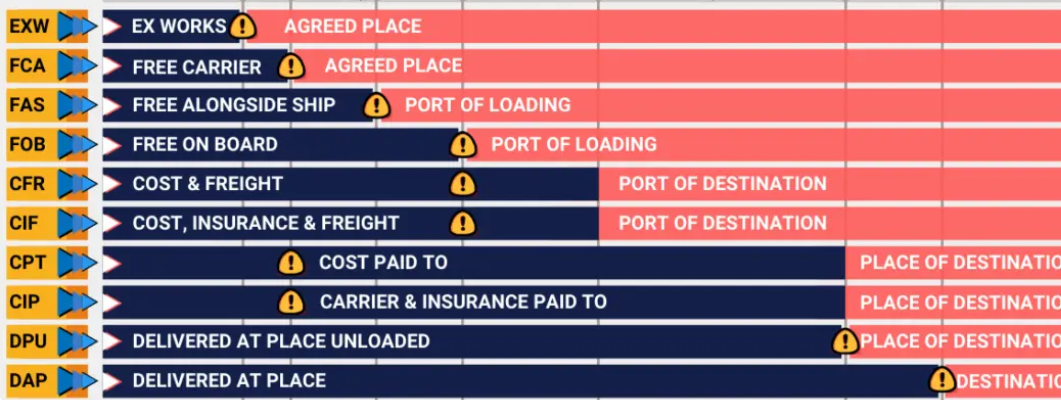
Door-to-Door (DDP) vs. Other Trade Terms
| Term | Division of responsibilities | Cost | Risk transfer point |
| DDP | The seller is responsible for the entire transportation, customs clearance and delivery | The seller bears all costs | After delivery to the buyer at the destination |
| DAP | The seller delivers the goods to the place designated by the buyer (without unloading) | The seller pays for shipping and the buyer pays for customs duties | Delivery to the buyer on the means of transport |
| CIF | The seller pays the freight + insurance until the destination port | Seller pays shipping + insurance | Over the ship’s rail at the port of loading |
| FOB | The seller is responsible for the cost of goods before shipment | Buyer pays shipping and subsequent costs | Over the ship’s rail at the port of loading |

Advantages and disadvantages of door to door
Advantages:
- Buyer’s peace of mind: No need to deal with complex shipping and customs clearance processes.
- Controllable costs: The seller’s quote includes all costs, eliminating hidden expenses (such as tariff fluctuations).
- Suitable for beginners: Reduces the risk of buyers’ lack of international trade experience.
Disadvantages:
- High seller risk: The seller bears risks such as shipping delays and customs detention.
- Higher costs: The seller typically passes this risk onto the price.
- Low flexibility: The buyer cannot independently choose a customs clearance agent or logistics provider.
Precautions
- Tariff Disputes: If actual tariffs are higher than the seller’s estimate, this may lead to disputes (the contract must clearly specify the tariff calculation method).
- Customs Clearance: Some countries (such as Brazil and Russia) require local customs clearance agents, which the seller should arrange in advance.
- Insurance Coverage: Ensure that the goods are insured for full transportation (such as war risk and theft insurance).
Door-to-door (DDP) is a one-stop logistics solution suitable for buyers seeking to streamline processes or sellers seeking to provide value-added services. Key to this is clearly defining the boundaries of liability (especially tariffs and risks). It’s recommended to include detailed contractual provisions for handling damage and delays. For high-value shipments, reputable international logistics providers (such as DHL, FedEx, and LangXu Freight) are preferred for door-to-door services.
How to Choose a Freight Forwarder in China: A Strategic Guide for Global Shippers
Selecting the right freight forwarder is one of the most critical decisions for importers and…
de minimis elimination 2026 china imports fba
For years, cross-border e-commerce ran on a simple, powerful premise: shipments valued at $800 or…

Tariff Engineering: How to Legally Cut Your US Import Duty Bill in 2026
By now in this series, you understand the compliance chain: Amazon FBA forces DDP terms,…

US Customs Clearance: ISF, POA, IOR Checklist — The 2026 Guide for Amazon FBA Sellers
You’ve chosen the right Incoterm (DDP, as Amazon FBA mandates) and your supplier is ready…
Incoterms 2020 Explained for E-commerce Sellers: EXW, FCA, FOB, CIF, DDP and How to Choose
If you’re sourcing from China and selling on Amazon, Shopify, or any cross-border platform, you’ve…
DDP vs. DAP for Amazon FBA: The Tariff Question Amazon Answers for You
If you’re sourcing from China and shipping to Amazon FBA, you’ve probably seen two quotes…