
If you’re sourcing products from Alibaba and selling in the US market, you’ve probably figured out one thing already: finding the product is the easy part. Getting it shipped reliably and affordably—that’s where most importers lose money or get burned.
This guide covers everything you need to know about shipping from Alibaba to the USA in 2026: shipping methods, real costs, transit times, customs duties, required documents, and how to avoid the mistakes that cost importers thousands of dollars every year.
Step 1: Find and Verify Suppliers on Alibaba
Before you think about shipping, you need a reliable supplier. Here’s what to look for:
- Trade Assurance: Only work with suppliers who have Alibaba Trade Assurance. This protects your payment if the supplier fails to deliver.
- Verified Supplier: Look for the “Verified” badge, which means Alibaba has audited their business.
- Gold Supplier: Suppliers with 3+ years as Gold Supplier are generally more stable.
- Response Rate: A supplier who responds within 2 hours is more likely to handle shipping issues promptly.
- Order Volume: Check their transaction history. A supplier who has shipped 1,000+ orders is a safer bet than one with 10.
Pro tip: Always request product samples before placing a large order. It costs $50–200 in express shipping, but it can save you from a$5,000 mistake.
Step 2: Negotiate Shipping Terms (Incoterms)
The shipping terms you agree on with your supplier determine who is responsible for what. Here are the most common Incoterms for Alibaba orders:
| Incoterm | Supplier Handles | You Handle | Best For |
|---|---|---|---|
| EXW (Ex Works) | Nothing | Everything (pickup, export, shipping, import) | Experienced importers with their own forwarder |
| FOB (Free on Board) | Delivery to Chinese port, export customs | Ocean/air freight, import customs, delivery | Most common for sea freight |
| CIF (Cost, Insurance, Freight) | Shipping to US port, insurance | Import customs, inland delivery | Importers who want simplicity |
| DDP (Delivered Duty Paid) | Everything including US customs and duties | Nothing | First-time importers who want full service |
Our recommendation: If this is your first time importing, go with DDP. Your freight forwarder handles everything from the supplier’s factory to your door, including US customs clearance and duty payment. You pay one price and receive your goods without surprises.
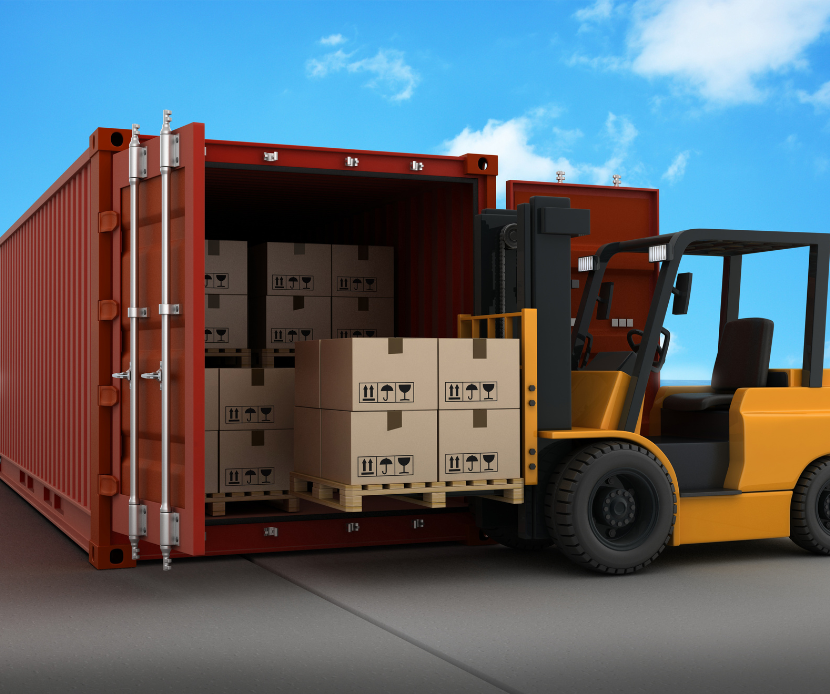
Step 3: Choose the Right Shipping Method
Express Freight (DHL, UPS, FedEx)
- Cost: $8–$20 per kg
- Transit time: 3–7 days
- Best for: Samples, urgent orders under 200 kg
- Not ideal for: Large shipments (too expensive)
Express is the fastest option but the most expensive per unit. Use it for samples or small test orders, not for regular bulk shipments.
Air Freight
- Cost: $3–$8 per kg
- Transit time: 5–10 days
- Best for: Orders between 200–1,000 kg, time-sensitive cargo
- Not ideal for: Very heavy or low-value goods
Air freight is the sweet spot for mid-sized orders. It’s significantly cheaper than express but much faster than sea freight. Most Amazon FBA sellers use air freight for restocking.
Sea Freight (FCL – Full Container Load)
- Cost: $1,800–$3,500 per 20ft container (China to US West Coast)
- Transit time: 25–35 days
- Best for: Large shipments (10+ CBM), heavy goods, cost-sensitive orders
- Not ideal for: Urgent shipments
FCL is the most cost-effective option per unit for large shipments. You get the entire container, which means less handling and lower risk of damage.
Sea Freight (LCL – Less than Container Load)
- Cost: $50–$80 per CBM
- Transit time: 30–40 days
- Best for: Small shipments (1–10 CBM)
- Not ideal for: Time-sensitive orders
LCL lets you share container space with other shippers. You only pay for the space you use, making it ideal for smaller orders that don’t fill a full container.
Rail Freight
- Cost: Between air and sea
- Transit time: 15–20 days
- Best for: Shipments to the US East Coast (via rail after arriving at a port)
- Not ideal for: West Coast destinations (sea is faster)
Step 4: Understand US Import Duties and Tariffs (2026)
This is where many first-time importers get caught off guard. In 2026, the tariff landscape has changed significantly:
- Base tariff on Chinese goods: The effective tariff rate on imports from China is currently around 20% (10% reciprocal tariff + 10% additional tariff). Some product categories may be higher.
- HTS Classification: Every product has an HTS (Harmonized Tariff Schedule) code that determines its duty rate. You can look up your product’s HTS code on the USITC website .
- De Minimis Threshold: As of 2026, the de minimis exemption for low-value shipments (under $800) from China has been suspended. This means ALL shipments from China are subject to duties, regardless of value.
How to calculate your total import cost:
Product Cost (FOB) + Shipping Cost + Customs Duty (%) + Customs Broker Fee ($150–$300) + Inland Delivery = Total Landed Cost
Example: If you buy $10,000 worth of electronics (20% duty rate):
- Product: $10,000
- Sea freight (FCL): $2,500
- Duty (20%): $2,000
- Customs broker: $200
- Inland delivery: $500
- Total landed cost: $15,200
Step 5: Required Documents for US Import
Make sure you have these documents ready before your shipment departs:
- Commercial Invoice: Details of the goods, value, and parties involved
- Bill of Lading (B/L): Proof of shipment issued by the carrier
- Packing List: Detailed list of all items, quantities, and weights
- CBP Entry Summary (CBP Form 7501): Filed by your customs broker
- Importer Security Filing (ISF 10+2): Must be filed 24 hours before the vessel departs from China
- Certificate of Origin: May be required for preferential duty rates
- Product-specific certificates: FDA, FCC, EPA, etc., depending on your product
Step 6: Choose the Right Freight Forwarder
This is the most important decision in the entire process. Here’s how to evaluate a freight forwarder:
Red Flags to Avoid
- Vague quotes: If they give you a single “total price” without breaking down origin fees, ocean freight, destination fees, and customs, walk away
- No physical address in China: Many “forwarders” are one-person operations with no warehouse
- No customs broker in the US: They’ll outsource customs clearance to a third party, adding cost and delays
- Unrealistically low prices: If it’s 50% cheaper than everyone else, there’s a reason
What to Look For
- Transparent pricing: Itemized quotes showing every fee
- Own warehouse in China: For consolidation, quality inspection, and repacking
- DDP capability: Can handle the entire process door-to-door
- Real-time tracking: You should be able to track your shipment at every stage
- Responsive communication: Replies within 2 hours during business hours
Step 7: The Complete Shipping Process
Here’s what the full process looks like, step by step:
- Place order with supplier → Confirm product specs, quantity, and shipping terms (EXW or FOB recommended)
- Hire freight forwarder → Share supplier contact, product details, and delivery address
- Supplier produces goods → 15–30 days (varies by product)
- Goods ready → Forwarder arranges pickup → Truck from factory to warehouse
- Quality inspection (optional but recommended) → Check goods before shipping
- Consolidation (if multiple suppliers) → Combine orders into one shipment
- Export customs clearance → Forwarder handles Chinese export procedures
- Main carriage → Sea (25–35 days) or air (5–10 days)
- Import customs clearance → Forwarder’s US partner handles CBP entry
- Duty payment → Paid to US Customs (or included in DDP price)
- Inland delivery → Truck from port to your warehouse or Amazon FBA
- Goods received → Inspect and confirm
Why Importers Choose Langxu for Alibaba Shipping
At Langxu International Logistics, we’ve been helping importers ship from Alibaba to the USA since our founding in Shenzhen. Here’s what sets us apart:
- DDP Expertise: We handle the entire process—from your supplier’s factory in China to your door in the US. No hidden fees, no surprises.
- Free Warehousing & Consolidation: Order from multiple Alibaba suppliers? We’ll receive, inspect, consolidate, and ship as one shipment—saving you up to 40% on shipping costs.
- Transparent Pricing: Every quote is itemized. You’ll know exactly what you’re paying for before you commit.
- Real-Time Tracking: Track your shipment 24/7 through our online system.
- US Customs Network: We have established relationships with US customs brokers, ensuring smooth clearance every time.
- All Cargo Types: General cargo, sensitive goods, batteries, branded products—we handle it all.
FAQ: Shipping from Alibaba to the USA
Ready to Ship from Alibaba to the USA?
Get a free, no-obligation quote from Langxu International Logistics. Tell us what you’re shipping, from where in China, and to where in the USA—and we’ll get back to you with a detailed, transparent quote within 2 hours.
[Get a Free Quote] | WhatsApp: +86 15272278788 | Email: jack@langxufreight.com
Shipping from Alibaba to Mexico: Complete Guide for Importers (2026)
Mexico has become one of the hottest import markets for Alibaba buyers. With the USMCA…
Shipping from Alibaba to Canada: Complete Guide for Importers (2026)
Canada is one of the top destinations for Alibaba importers. With a strong economy, high…
Shipping from Alibaba to the UK: Complete Guide for Importers (2026)
The UK remains one of Europe’s largest import markets, and Alibaba is the go-to sourcing…