
Discover the essential elements of commercial invoices in cross-border logistics. Our comprehensive guide simplifies the process for seamless international trade.
I. Overview
The Commercial Invoice (CI) is an indispensable document in international trade. It serves as written proof of a transaction between a buyer and a seller, recording detailed information about the goods, the transaction amount, and other essential data. The Commercial Invoice plays a critical role not only in payment settlement but also in customs clearance, bank negotiation, tax refunds, and accounting. This article will detail the definition, main functions, content requirements, and types of Commercial Invoices, along with their practical application in business, illustrated by real-world cases to further highlight their importance.
II. Definition and Functions of the Commercial Invoice
Definition
A Commercial Invoice is a document issued by the seller that records the detailed information of the sale of goods or services. It serves as the basis for the buyer to make payment and for the delivery of goods. It typically includes a description of the goods, quantity, unit price, total price, trade terms, method of payment, and other relevant information.
Main Functions
- Proof of Transaction:
The Commercial Invoice is written proof of a transaction between the buyer and seller. It details the quantity, price, and terms of the goods, serving as the basis for payment and delivery. - Basis for Settlement:
The buyer makes payment based on the content of the Commercial Invoice. Banks also use the Commercial Invoice as a basis for handling foreign exchange settlement. - Customs Document:
The Commercial Invoice is a crucial document during customs clearance. Customs authorities determine the declared value of the goods and the applicable tariff rates based on the invoice content. - Voucher for Tax Refunds:
When export enterprises apply for tax refunds, they are required to provide the Commercial Invoice as proof of the transaction. - Accounting Record:
The Commercial Invoice is an original voucher for enterprise accounting, serving as the basis for bookkeeping and auditing.
III. Content Requirements for a Commercial Invoice
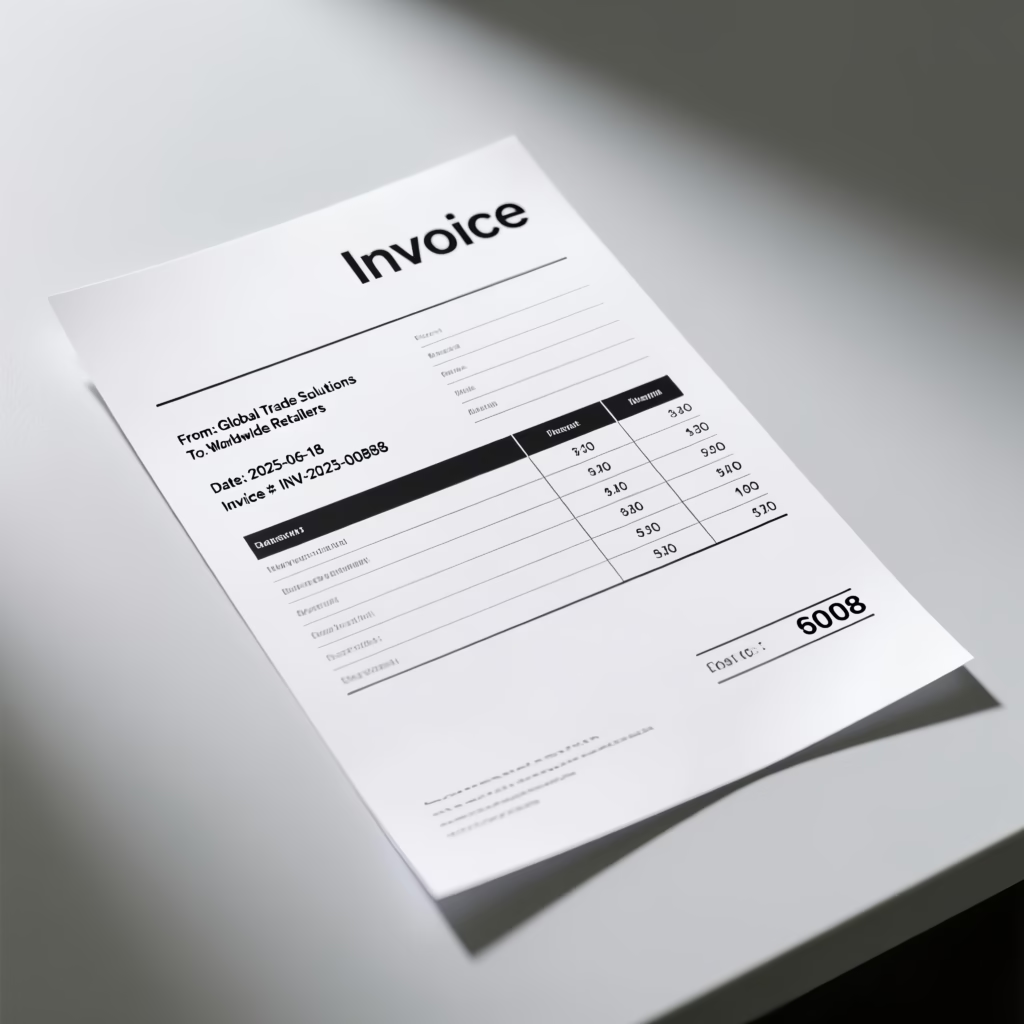
A complete Commercial Invoice should include the following main elements:
- Invoice Number: Each Commercial Invoice should have a unique number for easy recording and querying.
- Invoice Date: The date the invoice is issued, serving as a record of the transaction time.
- Seller Information: The seller’s company name, address, contact details, etc.
- Buyer Information: The buyer’s company name, address, contact details, etc.
- Description of Goods: A detailed description of the goods, including name, specifications, model, etc.
- Quantity: The quantity of the goods and the unit of measurement.
- Unit Price: The unit price of the goods and the currency used for pricing.
- Total Price: The total price of the goods and the currency used.
- Trade Terms: Such as FOB, CIF, etc., clarifying the responsibilities and cost allocation between buyer and seller.
- Payment Terms: Such as T/T, L/C, etc., clarifying the conditions and method of payment.
- Shipping Information: Including the port of loading, port of discharge, and mode of transportation.
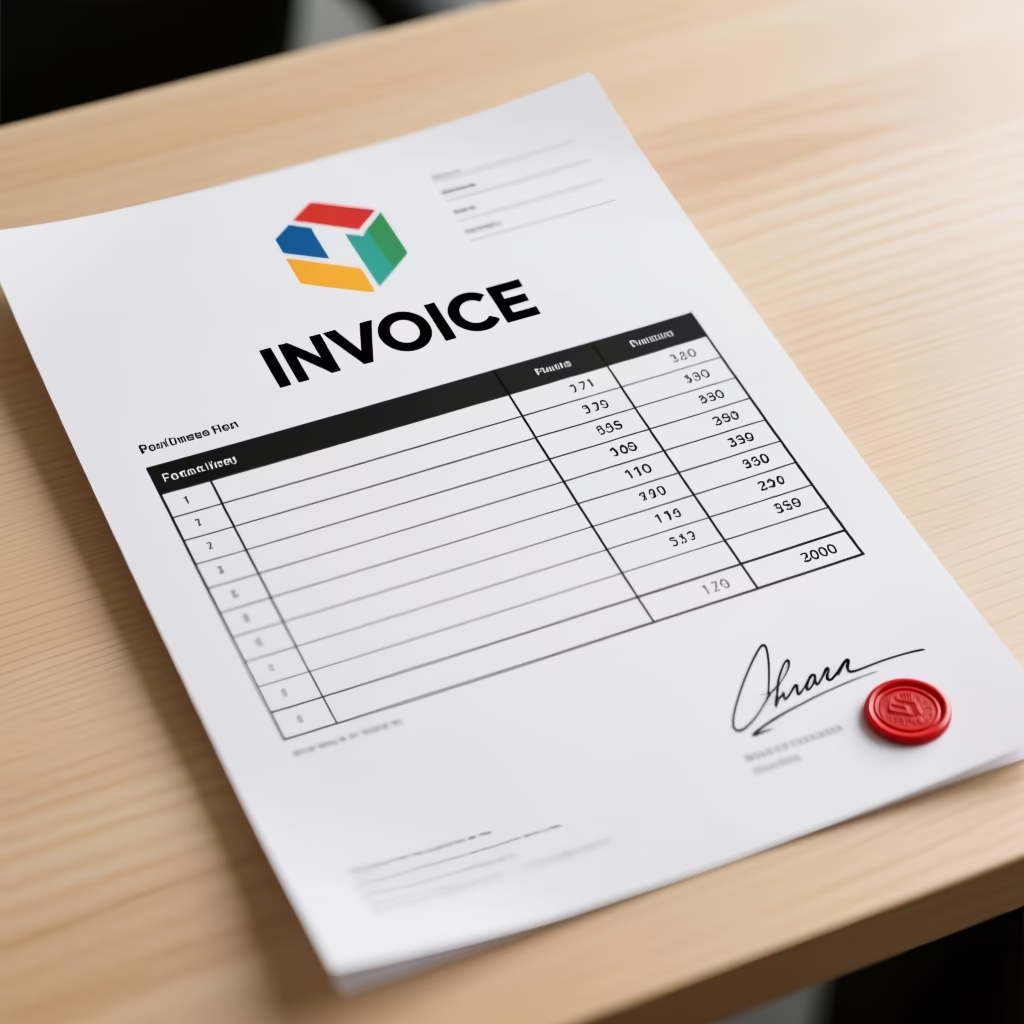
- Signature: The signature or seal of the seller, confirming the authenticity of the invoice content.
IV. Types of Commercial Invoices
Based on different usage scenarios and requirements, Commercial Invoices can be divided into the following types:
- Proforma Invoice (PI):
A Proforma Invoice is an estimated invoice provided by the seller before formal shipment. It is used for customs declaration, opening Letters of Credit, signing contracts, etc. - Final Invoice (FI):
A Final Invoice is the definitive invoice provided by the seller after the goods have been shipped. It serves as the basis for actual settlement. - Invoice Copy (IC):
An Invoice Copy is a photocopy or duplicate of the Final Invoice. It is usually used for internal records or provided to relevant parties for reference.
V. Applications of Commercial Invoices in Practical Business
The Commercial Invoice is widely used in international trade. Below are several typical application scenarios:
- Settlement and Payment:
The buyer makes payment based on the content of the Commercial Invoice, and banks handle settlement procedures based on the invoice. For example, a US company purchasing electronic products from a Chinese supplier: the Chinese supplier issues a Commercial Invoice based on the contract, and the US company makes payment based on the invoice, with the bank handling the settlement based on the invoice details. - Customs Declaration and Clearance:
The Commercial Invoice is an important document during customs declaration. Customs authorities determine the declared value and tariff rates based on the invoice content. For example, a German company exporting auto parts to the US must provide a Commercial Invoice during export customs declaration, and customs will determine the tariff rate based on the invoice. - Tax Refund Application:
Export enterprises need to provide a Commercial Invoice as a basis when applying for tax refunds. For example, a Chinese enterprise exporting garments to Europe needs to provide documents such as the Commercial Invoice to the tax authorities to apply for an export tax refund. - Accounting:
The Commercial Invoice is an original voucher for enterprise accounting, used for bookkeeping and auditing. For example, a Japanese company receiving payment from an overseas client needs to conduct accounting processing based on the Commercial Invoice to confirm revenue.
VI. Case Studies of Commercial Invoices
Case Study 1: Electronics Export
Background: A Chinese company exports a batch of electronic products to a client in the US with a total value of USD 50,000. The trade term is FOB Shanghai, and the payment method is Letter of Credit (L/C).
Commercial Invoice Content:
- Invoice Number: CI2023001
- Invoice Date: June 1, 2023
- Seller Information: ABC Electronics Co., Ltd., 123 XX Road, Pudong New Area, Shanghai
- Buyer Information: XYZ Inc., 456 XX Street, Manhattan, New York
- Description of Goods: Electronic products, Model ABC-123
- Quantity: 1,000 units
- Unit Price: USD 50/unit
- Total Price: USD 50,000
- Trade Terms: FOB Shanghai
- Payment Terms: Letter of Credit (L/C)
- Shipping Information: Port of Loading: Shanghai; Port of Discharge: Los Angeles; Mode of Transport: Sea Freight
- Signature: Seal of ABC Electronics Co., Ltd.
Application:
- Settlement and Payment: The US client opens a Letter of Credit based on the Commercial Invoice through their bank. The Chinese company applies for settlement with the bank using the Letter of Credit and Commercial Invoice.
- Customs Declaration and Clearance: The Chinese company provides the Commercial Invoice during customs declaration in Shanghai, and customs determines the declared value and tariff rate based on the invoice.
- Tax Refund Application: After completing the export, the Chinese company provides documents such as the Commercial Invoice to the tax authorities to apply for an export tax refund.
Case Study 2: Clothing Import
Background: A US company imports a batch of clothing from Italy with a total value of EUR 30,000. The trade term is CIF New York, and the payment method is Telegraphic Transfer (T/T).
Commercial Invoice Content:
- Invoice Number: CI2023056
- Invoice Date: July 10, 2023
- Seller Information: Fashion Italy S.p.A., 78 XX Avenue, Milan
- Buyer Information: USA Apparel Co., 89 XX Street, Brooklyn, New York
- Description of Goods: Clothing, Style FI-456
- Quantity: 500 pieces
- Unit Price: EUR 60/piece
- Total Price: EUR 30,000
- Trade Terms: CIF New York
- Payment Terms: Telegraphic Transfer (T/T)
- Shipping Information: Port of Loading: Genoa; Port of Discharge: New York; Mode of Transport: Sea Freight
- Signature: Seal of Fashion Italy S.p.A.
Application:
- Settlement and Payment: The US company makes payment via Telegraphic Transfer based on the content of the Commercial Invoice.
- Customs Declaration and Clearance: The US company provides the Commercial Invoice during customs declaration in New York, and customs determines the declared value and tariff rate based on the invoice.
- Accounting: The US company conducts accounting processing based on the Commercial Invoice to record the import cost.
VII. Important Considerations for Commercial Invoices
When issuing and using Commercial Invoices, the following points should be noted:
- Accurate Content: The content of the Commercial Invoice must be accurate, including the description of goods, quantity, price, terms, etc., to avoid disputes or delays caused by errors.
- Standard Format: The format of the Commercial Invoice should comply with international practices and relevant regulatory requirements to ensure it is recognized and accepted in international trade.
- Signature and Seal: The Commercial Invoice must be signed or stamped by the seller to confirm the authenticity and validity of its content.
- Timely Issuance: The Commercial Invoice should be issued promptly after the goods are shipped to avoid payment or customs clearance delays due to invoice delays.
- Retaining Copies: The seller should retain copies of the Commercial Invoice as transaction records and a basis for accounting.

Temu vs. Shein: Which App is Safer
By langxu freight | Updated: 2026 The battle for the top spot in the ultra-fast…
Mastering the Ocean Bill of Lading
In the fast-paced world of international logistics, cargo moves across oceans, but paperwork rules the…

e-commerce How to Secure Your Supply Chain and Amplify Your Brand
Your shop is growing. The adrenaline of the first few sales has settled into a…